


Before a process can be scored, it has to be drawn the same way by everyone who reads it. That is a notation problem, and it is the first thing that breaks in most digital transformation programs. Scopewell built its scoring methodology on BPMN, the only process notation that is an international standard, governed by a vendor-neutral consortium, and adopted across enterprises, vendors, and academia. This article is the reference behind that choice.
Table of contents
- Why the notation choice matters
- What BPMN is, in one paragraph
- A short history, and why governance matters
- The international standard: ISO/IEC 19510:2013
- Why BPMN beat the alternatives
- The three levels of BPMN, and who each one serves
- Inside the notation: elements, task types, semantics
- The community behind the standard
- What BPMN does not do well, and how we handle it
- BPMN as the structural base for digital maturity scoring
- Closing
- FAQ
1. Why the notation choice matters
Most digital transformation efforts fail at the same point: the company cannot agree on how its own work flows. Different departments draw it differently, consultants impose their own templates, and tools export shapes that no one else can read. The result is a stack of diagrams that look like process maps but cannot be compared, scored, or trusted.
Notation is not a cosmetic question. The notation you choose decides what can be measured, what can be automated, and what can be defended to a board. A proprietary diagram format locks the work to a vendor. An ad hoc flowchart locks it to the person who drew it. A standard notation makes the work portable, auditable, and ready for scoring.
Scopewell uses BPMN. This article explains why, in the same level of detail we would give to a CTO reviewing our methodology, and in plain enough terms for a CxO who needs to know whether the foundation is sound.
2. What BPMN is, in one paragraph
BPMN stands for Business Process Model and Notation. It is a graphical language for describing how work flows through an organization, using a small set of shapes (boxes for tasks, diamonds for decisions, circles for events, lanes for who does what). It is governed by the Object Management Group (OMG), specified in the OMG BPMN 2.0 standard, and recognized internationally as ISO/IEC 19510:2013. It is used by enterprises, software vendors, consulting firms, and universities worldwide, with no license fees and no single-vendor owner.
3. A short history, and why governance matters
BPMN was created inside the Business Process Management Initiative (BPMI), a vendor consortium formed in late 2000. The Notation Working Group was chaired by Stephen A. White of IBM, widely referred to as the father of BPMN. The first public version, BPMN 1.0, was released in May 2004 after more than two years of work involving roughly 25 to 30 tool vendors.
In June 2005, BPMI merged with the Object Management Group, transferring stewardship to a larger, vendor-neutral, not-for-profit standards body founded in 1989. OMG also maintains UML, DMN (Decision Model and Notation), and CMMN (Case Management Model and Notation). OMG published the formal BPMN specification in February 2006.
Versions followed in sequence:
- BPMN 1.0 (2004)
- BPMN 1.1 (January 2008)
- BPMN 1.2 (January 2009)
- BPMN 2.0 (2011, the major rewrite that added formal execution semantics)
- BPMN 2.0.1 (2013, adopted as ISO)
- BPMN 2.0.2 (January 2014, the current formal version)
The companies that contributed to BPMN 2.0 read like a census of enterprise software. IBM, Oracle, SAP, Software AG, TIBCO, Unisys, Axway, Bizagi, IDS Scheer, MEGA International, Model Driven Solutions, PNA Group, and Bruce Silver Associates were all on the working groups.
This matters. A standard owned by a consortium of competitors cannot be captured by one vendor's roadmap, discontinued for commercial reasons, or turned into a paywalled format. That governance model is what makes BPMN safe to build a methodology on.
4. The international standard: ISO/IEC 19510:2013
In July 2013, BPMN 2.0.1 was published as ISO/IEC 19510:2013. The ISO text is identical to the OMG specification and was prepared by ISO/IEC Joint Technical Committee JTC 1 under the Publicly Available Specification procedure.
The standard states its purpose directly: to provide a notation that is readily understandable by all business users, and to create a standardized bridge for the gap between business process design and process implementation.
For a CxO, the practical meaning is simple. BPMN is an international standard, on the same shelf as the ISO standards governing quality management, information security, and accounting. When Scopewell maps a process in BPMN, the output is portable, durable, and recognized outside our platform.
5. Why BPMN beat the alternatives
The notation choice was not obvious in 2004. Several candidates competed for the same ground.
- UML Activity Diagrams, maintained by the same OMG, came from software engineering. They were precise but built for developers, not for business users. They lacked the swimlane and message-flow expressiveness needed to model how work actually moves between people, departments, and systems.
- Event-driven Process Chains (EPC), created by August-Wilhelm Scheer at the University of Saarland in the early 1990s and embedded in the ARIS toolset, was strong for enterprise-architecture analysis but tied to a specific methodology and weaker as a bridge to execution.
- IDEF and plain flowcharts had no standardized semantics. Two diagrams that looked identical could mean different things to different readers.
BPMN won by combining two things that had not previously been combined. The visual layer was familiar enough that business users could read it without training. The underlying model was precise enough that engineers could execute it. The boxes, arrows, diamonds, and swimlanes resembled the flowcharts business people already knew, while the formal semantics defined behavior unambiguously.
Bruce Silver, a member of the BPMN 2.0 technical committee and author of BPMN Method and Style, frames the outcome precisely. The significance of BPMN, he writes, lies not in being superior to other process notations, but in its status as a multi-vendor standard, maintained by the Object Management Group, and its wide adoption by modelers and tool vendors alike.
6. The three levels of BPMN, and who each one serves
The specification formalizes three conformance subclasses, often called the three levels of BPMN use. This layering is the reason BPMN works for very different audiences without changing notation.
- Level 1, Descriptive. A small palette of flowchart-like shapes for business users mapping current state. Readable in minutes by anyone in the business.
- Level 2, Analytic. Adds data objects, message flows, pools, lanes, and event handling. Used by analysts to simulate, validate, and optimize.
- Level 3, Common Executable. Adds the elements needed by a process engine to run the process, including service tasks, script tasks, timers, signals, and compensation handling.
The same diagram can be read at increasing depth by different stakeholders. A CxO reads the descriptive view to understand how value is created, an operations manager reads the analytic view to identify bottlenecks, and a technical lead reads the executable view to understand what can be automated, all without switching tools or learning a different notation.
BPMN serves the CxO and the transformation officer with the same artifact, which is the practical answer to who Scopewell is for.
7. Inside the notation: elements, task types, semantics
BPMN organizes its notation into four element categories:
- Flow objects: events (circles), activities (rounded rectangles), and gateways (diamonds).
- Connecting objects: sequence flows, message flows, and associations.
- Swimlanes: pools (participants) and lanes (roles or functions within a participant).
- Artifacts: data objects, groups, and annotations.
Events come in start, intermediate, and end forms, and can catch or throw triggers such as messages, timers, errors, signals, and escalations. Gateways control branching and merging logic: exclusive (one path taken), parallel (all paths taken), inclusive, and event-based. Activities can be atomic tasks, subprocesses, or call activities that reference reusable processes.
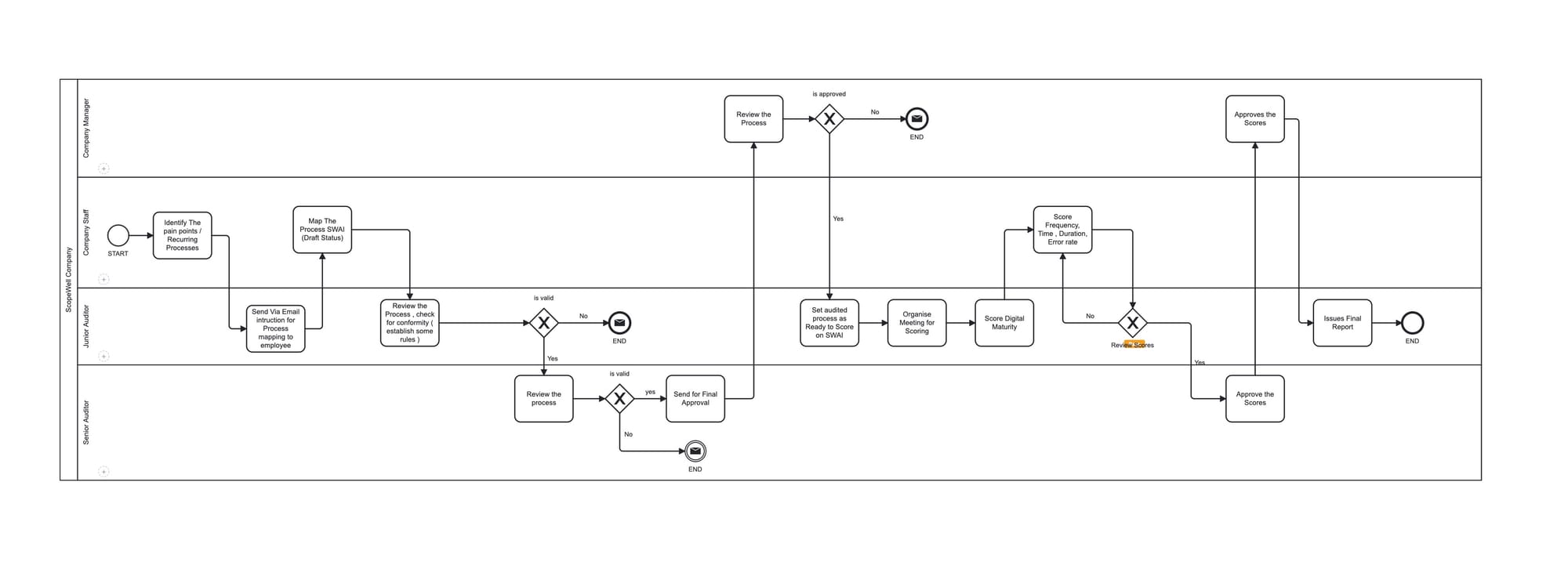
The element that turns BPMN from a drawing into an instrument is the task type. The specification defines distinct types of task, each carrying a visual marker:
- Service task: executed automatically by a system, API, or web service, with no human involvement.
- Script task: executed by the process engine running a script.
- Business rule task: invokes a decision engine, the formal hook to DMN.
- User task: performed by a person working through a system interface.
- Manual task: performed by a person with no system support.
- Send and receive tasks: handle message exchange between participants.
Execution behavior is defined by token semantics. A token is created at the start event, advances along sequence flows as steps complete, splits and merges at gateways, and is consumed at an end event. The process instance ends when all tokens are consumed. This token model gives BPMN unambiguous, simulatable execution behavior.
BPMN models serialize to a standardized XML format, including diagram-interchange data. A BPMN model is a file. It can be parsed, validated, transformed, scored, and compared programmatically. This is what allows a structured process library to feed a consistent scoring engine.
8. The community behind the standard
A standard is only as strong as the community that maintains it. BPMN is supported by four mutually reinforcing layers.
Specification and governance. The OMG BPMN specification and ISO/IEC 19510:2013 are the primary documents. OMG also publishes Stephen White's accessible Introduction to BPMN, which remains a useful primer almost two decades after it was written.
Certification. OMG runs a formal certification track, OCEB 2 (OMG Certified Expert in BPM), structured across Fundamental, Intermediate, and Advanced levels on Business and Technical tracks. The Fundamental syllabus is built directly on BPMN 2.0's Descriptive and Analytic conformance subclasses. The certification gives the standard a defined competency framework, which is rare among process modeling languages.
Academic community. The International Conference on Business Process Management has run since 2003, when the first edition in Eindhoven was organized by Wil van der Aalst, Arthur ter Hofstede, and Mathias Weske. The series sustains the research that keeps the standard rigorous. BPM 2025 in Seville drew nearly 400 participants from 39 countries.
Literature. Bruce Silver's BPMN Method and Style is the authoritative practitioner reference. Silver's central argument is that a BPMN diagram should have one and only one interpretation, and one and only one XML serialization. That principle is what makes BPMN scorable rather than merely drawable.
BPMN is documented by an international standards body, taught through a recognized certification, debated in an annual academic conference, and codified in a body of published method-and-style work. No proprietary diagram format comes close.
9. What BPMN does not do well, and how we handle it
We are using BPMN, not selling it, and honest use means acknowledging the limits.
Complexity. The full BPMN 2.0 specification carries 116 distinct elements, more than double the 55 in version 1.x. Critics call this too much to learn and too easy to misuse. The counterargument is empirical and decisive. In a 2008 study of 120 real-world BPMN diagrams, How Much Language Is Enough?, zur Muehlen and Recker found that the average model contains just 9 different BPMN constructs, and that less than 20 percent of the vocabulary is regularly used. Disciplined practice operates well below the full element count.
Our response: Scopewell standardizes on a constrained, curated subset of BPMN across our process library. The 25 processes in our v1 professional services library use the same core palette. This makes diagrams comparable across processes and across companies, which is the precondition for scoring. Using the 9 main shapes carries out 90% of your business process needs. Simple enough.
The descriptive-executable gap. A diagram drawn for human reading is rarely complete enough to execute without additional detail. BPMN's XML interoperability between tools has also been imperfect in practice. The fix is the same: constrain the model, validate the XML, and treat the diagram as data, not as decoration.
Unstructured work. BPMN models prescriptive, repeatable flows well. It is poorly suited to knowledge-driven, unpredictable work where the path changes with the case. This is why OMG created CMMN. In our methodology, processes that resist clean BPMN modeling are flagged as such, and they are not forced into a notation that distorts them.
These limitations are real, and they define where the standard applies rather than invalidate it.
10. BPMN as the structural base for digital maturity scoring
Most digital maturity frameworks operate at the strategic level. Deloitte's Digital Maturity Model, MIT and Capgemini's digital mastery work, the Forrester Digital Maturity Model, and the BCG Digital Acceleration Index all assess organizations on broad dimensions: strategy, leadership, customer, culture, operations, technology. They are valuable boardroom lenses. They were designed for large enterprises with the specialist capacity to run them.
The mid-market problem is different. A 200-person company does not need a 60-dimension maturity grid. It needs to know which of its actual operating processes is digitally mature, which is not, and where to act. Strategic maturity frameworks do not answer that question, because they do not operate at the level of the process.
That is the gap Scopewell fills, and it is the reason the foundation has to be BPMN.
A standard, machine-readable process notation lets digital maturity be measured at the level where work actually happens. When every process in the library is modeled in the same notation, with the same task types, the same gateway types, the same event types, and the same swimlane conventions, the maturity assessment becomes structural rather than declarative. It is computed from the model, not collected from a survey.
Concretely, BPMN structure feeds the Scopewell Digital Maturity score (DM) through five readable signals:
- Task typing. The presence and balance of service, script, business rule, user, and manual tasks indicates how much of the work is supported by systems, how much is decided by rules, and how much is still carried by people.
- Data objects and message flows. What data exists, where it moves, and where it is missing reveals the digital footprint of the process.
- Gateways and exception paths. The clarity and structure of decision logic indicates whether the process is governed by codified rules or by tacit judgment.
- Timer and intermediate events. Modeled waits show where digital handoffs are absent.
- Lane structure. Pools and lanes expose whether the process is digitally orchestrated end to end, or stitched together across systems and people.
None of these signals requires a survey or depends on what someone says about a process. They are read from the model itself. Because the model is BPMN, the same signals can be read from any process in any company in our library, and the resulting maturity scores are comparable.
This is the reason the notation choice came first, and the scoring methodology second. Scoring on a non-standard notation produces non-comparable scores. Scoring on BPMN produces scores that can be defended, reproduced, and benchmarked. The standard is the spine. The scoring is what we built on top of it.
11. Closing
BPMN is the only process notation that is simultaneously visually approachable, technically precise, internationally standardized through ISO/IEC 19510:2013, and stewarded by a vendor-neutral consortium.
We use it because we are building a scoring methodology, and scoring requires comparability, and comparability requires a shared notation that no one owns.
The standard is the foundation. The maturity score, the process library, the prioritized roadmap, all of it rests on the assumption that the underlying diagrams mean the same thing to everyone who reads them. BPMN is what makes that assumption hold.
FAQ
What is the difference between BPMN and a regular flowchart?
A flowchart has shapes but no defined meaning behind them, so two people can draw the same process in two different ways and a reader cannot tell whether a diamond means a decision, a junction, or a manual sorting step. BPMN fixes this by attaching precise semantics to every shape, distinguishing tasks from events, exclusive gateways from parallel ones, and user work from automated work. The same diagram means the same thing to everyone who reads it, and to any tool that processes it.
Do we need to learn BPMN to use Scopewell?
No. The descriptive level of BPMN uses fewer than ten shapes, all of which are recognizable on sight, and the platform is designed so that business users can read and validate process maps without formal training. The deeper modeling work is handled in the platform layer and during audit engagements, where the standard's full expressive power is applied without requiring the business audience to master it.
Why BPMN rather than Visio or Lucidchart?
Visio and Lucidchart are drawing tools. They can render BPMN shapes, but they do not enforce BPMN semantics, validate the model, or produce structured XML that can be scored programmatically. The diagram looks the same and means nothing the same. Scopewell uses BPMN as a standard, not as a shape library, which is what allows the scoring methodology to work on the underlying model rather than on the picture.
How does BPMN-based scoring differ from survey-based maturity assessments?
Survey-based assessments collect what people say about their processes. BPMN-based scoring measures what the processes actually do, by reading task types, gateway density, lane crossings, and wait events directly from the model. The first method depends on the honesty and consistency of respondents. The second produces auditable, repeatable metrics that compare across processes and across companies.
Is BPMN still relevant in the age of AI and agentic automation?
Yes, and more so than before. AI agents and automation systems need a clear specification of where they fit into a process, what triggers them, what they receive, and what they return. BPMN provides exactly that specification through service tasks, business rule tasks, and message events, and its standardized structure is what makes it possible to identify which steps in a process are good candidates for AI deployment in the first place.
Scopewell is the platform that maps and scores your processes into a ranked AI and automation roadmap.